
What is Private Cellular?
Rapid Deployment Cell Kit: Private LTE for Teams That Need Their Own Network
The Rapid Deployment Cell Kit is a rugged, self-hosted private LTE system built for teams that need local, high-throughput communications without relying entirely on public cell towers, Wi-Fi, or expensive military-grade MANET radios.
In plain English: this kit lets you stand up your own small cellular network, connect phones or LTE devices with approved SIMs, and run ATAK services locally.

What is private LTE?
Private LTE is a cellular network that you own and operate for your team, site, vehicle group, event, facility, or field operation. It works like a normal LTE cell network, but instead of connecting to a carrier tower, your devices connect to your own base station and your own LTE core.
The big difference is control. With private LTE, you decide which SIM cards are allowed on the network, where the network is deployed, what services are available, and whether traffic stays local or routes out through an upstream connection like Starlink, fiber, or a normal router.
How does it work?
A private LTE network has three basic pieces:
1. The base station
This is the radio that phones, tablets, modems, cameras, or routers connect to over LTE. In LTE, this is commonly called an eNodeB. It is the part that creates the actual cellular coverage area.
2. The LTE core
This is the server-side brain of the network. It authenticates SIM cards, assigns device IP addresses, manages sessions, and routes traffic. The Rapid Deployment Cell Kit uses Open5GS for this role.
3. The SIM cards and user devices
Only devices with programmed SIMs can join the network. That gives private LTE a clean access-control model: no shared Wi-Fi password, no mystery clients, and no public carrier dependency for local communications.
Once the system is powered up, your team’s devices attach to the private LTE network the same way a phone attaches to a normal carrier. From there, they can reach local services such as ATAK/OpenTAKServer, local cameras, local sensors, or any IP service you choose to host.

Why use private LTE instead of just Wi-Fi, LoRa, or MANET?
There is no single perfect radio system. The right answer depends on what you need to move: short text messages, GPS points, ATAK data, voice, video, IP traffic, or full team networking.
Private LTE sits in a very useful middle ground. It gives you much more throughput than LoRa/Meshtastic, more structure and device control than many DIY mesh builds, and a much lower cost of entry than high-end tactical MANET systems.
In our testing, practical range has been roughly 1–5 km in urban environments and 10+ km with good line of sight. Actual range will always depend on antenna height, terrain, buildings, RF noise, device antennas, power, and local spectrum conditions.
Comparison: private LTE vs. LoRa, DIY MANET, and high-end MANET
| Option | Best for | Strengths | Tradeoffs |
|---|---|---|---|
| LoRa / Meshtastic | Text messages, GPS positions, small telemetry, low-power off-grid comms | Very low cost, long range, low power, easy to carry | Very low bandwidth. Great for short messages and position data, not for normal IP networking, video, or heavy ATAK use. |
| DIY MANET / Wi-Fi HaLow / OpenMANET-style builds | Budget IP mesh, ATAK over local IP, hobbyist or civilian field networking | Lower cost than military MANET, IP-native, can work well when nodes are placed correctly | More DIY setup, more tuning, performance drops as hops increase, and each node depends heavily on placement and power. |
| Private LTE with the Rapid Deployment Cell Kit | Team LTE coverage, ATAK, phones/tablets, routers, cameras, and general IP traffic | Strong middle ground: SIM-based access control, good throughput, familiar phone/device behavior, centralized network management, and better area coverage than standard Wi-Fi | Requires a powered base station and core. It is not a peer-to-peer mesh; if a cell site is down, coverage from that site is down. Spectrum rules and deployment conditions matter. |
| High-end tactical MANET, such as Silvus or MPU5 | Military, public safety, unmanned systems, high-end mobile mesh, demanding RF environments | Excellent performance, rugged hardware, advanced mesh behavior, high throughput, mobility, and specialized features | Expensive, proprietary, and often overkill for teams that mainly need a deployable broadband network for ATAK and IP devices. |
The simple way to think about it
- LoRa is great when you need tiny messages to go far.
- DIY MANET is great when you want cheap IP mesh and are willing to tinker.
- High-end MANET is great when budget is secondary to tactical performance.
- Private LTE is the practical middle: real IP bandwidth, real range, SIM-controlled access, and a cost that is still reachable for smaller teams.
Why private LTE is a strong middle-ground option
Private LTE gives you a real broadband network in the field without requiring every device to become a mesh node. Your users connect like they would to a normal cell network. Your ATAK devices, LTE routers, cameras, and sensors can all live on the same private IP network.
Compared to LoRa/Meshtastic, private LTE can move far more data. LoRa is excellent for short messages, GPS, and low-power telemetry, but it is not designed for heavy broadband traffic.
Compared to Wi-Fi HaLow or DIY MANET, private LTE gives you a more carrier-like architecture: SIM provisioning, centralized control, and devices that simply attach to the network instead of needing to participate in a mesh.
Compared to Silvus or MPU5-class MANET radios, private LTE is not trying to be a full military MANET replacement. Those systems are purpose-built for mobile peer-to-peer mesh, tactical environments, and advanced waveform features. But for many teams, the actual need is simpler: get ATAK, maps, local services, cameras, and IP devices online over a few kilometers. That is where private LTE makes a lot of sense.
What is Open5GS?
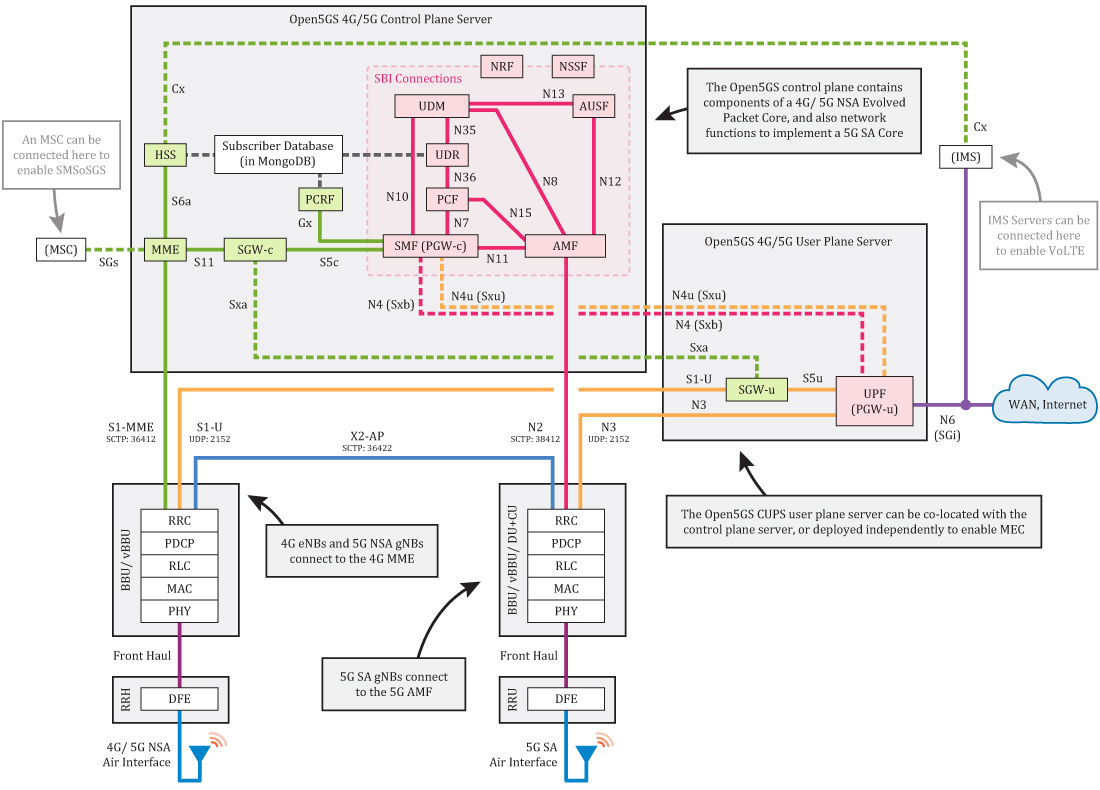
Open5GS is the open-source cellular core used by the kit. It provides the LTE EPC and 5G core network functions that let your private cellular network authenticate SIMs, manage sessions, and route user data.
In this kit, Open5GS is what makes the private LTE network “real.” The base station handles the radio link. Open5GS handles the subscriber database, authentication, mobility/session control, and packet routing behind the scenes.
Learn more: Open5GS official documentation
What is OpenTAKServer?
OpenTAKServer is an open-source TAK server for ATAK, iTAK, and WinTAK. It gives your team a local TAK backend that can run over the private LTE network.
That means ATAK clients can share position, markers, data packages, and other team information without depending entirely on a public internet connection. When paired with private LTE, OpenTAKServer helps turn the kit into a deployable team-networking platform.
Learn more: OpenTAKServer documentation
Where this kit fits
This kit is for users who need more than a LoRa text mesh, but do not want to spend into military MANET territory just to get ATAK and broadband IP coverage.
Good fits include:
- Field teams running ATAK
- Training sites
- Search and rescue groups
- Remote properties
- Events and temporary sites
- Vehicle or trailer-based comms kits
- Backup network deployments
- Local camera, sensor, and IP device networks
It is not magic, and it is not a substitute for planning. Antenna placement, power, terrain, line of sight, and spectrum rules still matter. But for teams that need a practical broadband field network, private LTE offers a powerful balance of range, throughput, cost, and control.